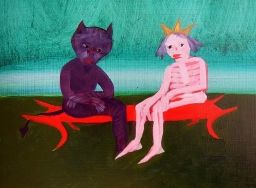
☇ ☈ ☍ ☊ ☩
You have been invaded by the freezine of fantasy
and science fiction. You no longer need to sub-
scribe, for we are already subscribed to you.


Thursday, March 27, 2014

RUE BARRÉE: I

by Robert W. Chambers


"For let Philosopher and Doctor preach
Of what they will and what they will not,—each
Is but one link in an eternal chain
That none can slip nor break nor over-reach."
"Crimson nor yellow roses nor
The savour of the mounting sea
Are worth the perfume I adore
That clings to thee.
The languid-headed lilies tire,
The changeless waters weary me;
I ache with passionate desire
Of thine and thee.
There are but these things in the world—
Thy mouth of fire,
Thy breasts, thy hands, thy hair upcurled
And my desire."


I


One morning at Julian's, a student said to Selby, "That is Foxhall Clifford," pointing with his brushes at a young man who sat before an easel, doing nothing.

Selby, shy and nervous, walked over and began: "My name is Selby,—I have just arrived in Paris, and bring a letter of introduction—" His voice was lost in the crash of a falling easel, the owner of which promptly assaulted his neighbour, and for a time the noise of battle rolled through the studios of MM. Boulanger and Lefebvre, presently subsiding into a scuffle on the stairs outside. Selby, apprehensive as to his own reception in the studio, looked at Clifford, who sat serenely watching the fight.

"It's a little noisy here," said Clifford, "but you will like the fellows when you know them." His unaffected manner delighted Selby. Then with a simplicity that won his heart, he presented him to half a dozen students of as many nationalities. Some were cordial, all were polite. Even the majestic creature who held the position of Massier, unbent enough to say: "My friend, when a man speaks French as well as you do, and is also a friend of Monsieur Clifford, he will have no trouble in this studio. You expect, of course, to fill the stove until the next new man comes?"

"Of course."

"And you don't mind chaff?"

"No," replied Selby, who hated it.

Clifford, much amused, put on his hat, saying, "You must expect lots of it at first."

Selby placed his own hat on his head and followed him to the door.

As they passed the model stand there was a furious cry of "Chapeau! Chapeau!" and a student sprang from his easel menacing Selby, who reddened but looked at Clifford.

"Take off your hat for them," said the latter, laughing.

A little embarrassed, he turned and saluted the studio.

"Et moi?" cried the model.

"You are charming," replied Selby, astonished at his own audacity, but the studio rose as one man, shouting: "He has done well! he's all right!" while the model, laughing, kissed her hand to him and cried: "À demain beau jeune homme!"

All that week Selby worked at the studio unmolested. The French students christened him "l'Enfant Prodigue," which was freely translated, "The Prodigious Infant," "The Kid," "Kid Selby," and "Kidby." But the disease soon ran its course from "Kidby" to "Kidney," and then naturally to "Tidbits," where it was arrested by Clifford's authority and ultimately relapsed to "Kid."

Wednesday came, and with it M. Boulanger. For three hours the students writhed under his biting sarcasms,—among the others Clifford, who was informed that he knew even less about a work of art than he did about the art of work. Selby was more fortunate. The professor examined his drawing in silence, looked at him sharply, and passed on with a non-committal gesture. He presently departed arm in arm with Bouguereau, to the relief of Clifford, who was then at liberty to jam his hat on his head and depart.

The next day he did not appear, and Selby, who had counted on seeing him at the studio, a thing which he learned later it was vanity to count on, wandered back to the Latin Quarter alone.

Paris was still strange and new to him. He was vaguely troubled by its splendour. No tender memories stirred his American bosom at the Place du Châtelet, nor even by Notre Dame. The Palais de Justice with its clock and turrets and stalking sentinels in blue and vermilion, the Place St. Michel with its jumble of omnibuses and ugly water-spitting griffins, the hill of the Boulevard St. Michel, the tooting trams, the policemen dawdling two by two, and the table-lined terraces of the Café Vacehett were nothing to him, as yet, nor did he even know, when he stepped from the stones of the Place St. Michel to the asphalt of the Boulevard, that he had crossed the frontier and entered the student zone,—the famous Latin Quarter.

A cabman hailed him as "bourgeois," and urged the superiority of driving over walking. A gamin, with an appearance of great concern, requested the latest telegraphic news from London, and then, standing on his head, invited Selby to feats of strength. A pretty girl gave him a glance from a pair of violet eyes. He did not see her, but she, catching her own reflection in a window, wondered at the colour burning in her cheeks. Turning to resume her course, she met Foxhall Clifford, and hurried on. Clifford, open-mouthed, followed her with his eyes; then he looked after Selby, who had turned into the Boulevard St. Germain toward the rue de Seine. Then he examined himself in the shop window. The result seemed to be unsatisfactory.

"I'm not a beauty," he mused, "but neither am I a hobgoblin. What does she mean by blushing at Selby? I never before saw her look at a fellow in my life,—neither has any one in the Quarter. Anyway, I can swear she never looks at me, and goodness knows I have done all that respectful adoration can do."

He sighed, and murmuring a prophecy concerning the salvation of his immortal soul swung into that graceful lounge which at all times characterized Clifford. With no apparent exertion, he overtook Selby at the corner, and together they crossed the sunlit Boulevard and sat down under the awning of the Café du Cercle. Clifford bowed to everybody on the terrace, saying, "You shall meet them all later, but now let me present you to two of the sights of Paris, Mr. Richard Elliott and Mr. Stanley Rowden."

The "sights" looked amiable, and took vermouth.

"You cut the studio to-day," said Elliott, suddenly turning on Clifford, who avoided his eyes.

"To commune with nature?" observed Rowden.

"What's her name this time?" asked Elliott, and Rowden answered promptly, "Name, Yvette; nationality, Breton—"

"Wrong," replied Clifford blandly, "it's Rue Barrée."

The subject changed instantly, and Selby listened in surprise to names which were new to him, and eulogies on the latest Prix de Rome winner. He was delighted to hear opinions boldly expressed and points honestly debated, although the vehicle was mostly slang, both English and French. He longed for the time when he too should be plunged into the strife for fame.

The bells of St. Sulpice struck the hour, and the Palace of the Luxembourg answered chime on chime. With a glance at the sun, dipping low in the golden dust behind the Palais Bourbon, they rose, and turning to the east, crossed the Boulevard St. Germain and sauntered toward the École de Médecine. At the corner a girl passed them, walking hurriedly. Clifford smirked, Elliott and Rowden were agitated, but they all bowed, and, without raising her eyes, she returned their salute. But Selby, who had lagged behind, fascinated by some gay shop window, looked up to meet two of the bluest eyes he had ever seen. The eyes were dropped in an instant, and the young fellow hastened to overtake the others.

"By Jove," he said, "do you fellows know I have just seen the prettiest girl—" An exclamation broke from the trio, gloomy, foreboding, like the chorus in a Greek play.

"Rue Barrée!"

"What!" cried Selby, bewildered.

The only answer was a vague gesture from Clifford.

Two hours later, during dinner, Clifford turned to Selby and said, "You want to ask me something; I can tell by the way you fidget about."

"Yes, I do," he said, innocently enough; "it's about that girl. Who is she?"

In Rowden's smile there was pity, in Elliott's bitterness.

"Her name," said Clifford solemnly, "is unknown to any one, at least," he added with much conscientiousness, "as far as I can learn. Every fellow in the Quarter bows to her and she returns the salute gravely, but no man has ever been known to obtain more than that. Her profession, judging from her music-roll, is that of a pianist. Her residence is in a small and humble street which is kept in a perpetual process of repair by the city authorities, and from the black letters painted on the barrier which defends the street from traffic, she has taken the name by which we know her,—Rue Barrée. Mr. Rowden, in his imperfect knowledge of the French tongue, called our attention to it as Roo Barry—"

"I didn't," said Rowden hotly.

"And Roo Barry, or Rue Barrée, is to-day an object of adoration to every rapin in the Quarter—"

"We are not rapins," corrected Elliott.

"I am not," returned Clifford, "and I beg to call to your attention, Selby, that these two gentlemen have at various and apparently unfortunate moments, offered to lay down life and limb at the feet of Rue Barrée. The lady possesses a chilling smile which she uses on such occasions and," here he became gloomily impressive, "I have been forced to believe that neither the scholarly grace of my friend Elliott nor the buxom beauty of my friend Rowden have touched that heart of ice."

Elliott and Rowden, boiling with indignation, cried out, "And you!"

"I," said Clifford blandly, "do fear to tread where you rush in."


Click Below
for Part II of
RUE BARRÉE


Wednesday, March 26, 2014

THE STREET OF OUR LADY OF THE FIELDS: VI

by Robert W. Chambers


VI


It was with another quick heart-beat that he awoke next morning, for his first thought was of Valentine.

The sun already gilded the towers of Notre Dame, the clatter of workmen's sabots awoke sharp echoes in the street below, and across the way a blackbird in a pink almond tree was going into an ecstasy of trills.

He determined to awake Clifford for a brisk walk in the country, hoping later to beguile that gentleman into the American church for his soul's sake. He found Alfred the gimlet-eyed washing the asphalt walk which led to the studio.

"Monsieur Elliott?" he replied to the perfunctory inquiry, "je ne sais pas."

"And Monsieur Clifford," began Hastings, somewhat astonished.

"Monsieur Clifford," said the concierge with fine irony, "will be pleased to see you, as he retired early; in fact he has just come in."

Hastings hesitated while the concierge pronounced a fine eulogy on people who never stayed out all night and then came battering at the lodge gate during hours which even a gendarme held sacred to sleep. He also discoursed eloquently upon the beauties of temperance, and took an ostentatious draught from the fountain in the court.

"I do not think I will come in," said Hastings.

"Pardon, monsieur," growled the concierge, "perhaps it would be well to see Monsieur Clifford. He possibly needs aid. Me he drives forth with hair-brushes and boots. It is a mercy if he has not set fire to something with his candle."

Hastings hesitated for an instant, but swallowing his dislike of such a mission, walked slowly through the ivy-covered alley and across the inner garden to the studio. He knocked. Perfect silence. Then he knocked again, and this time something struck the door from within with a crash.

"That," said the concierge, "was a boot." He fitted his duplicate key into the lock and ushered Hastings in. Clifford, in disordered evening dress, sat on the rug in the middle of the room. He held in his hand a shoe, and did not appear astonished to see Hastings.

"Good-morning, do you use Pears' soap?" he inquired with a vague wave of his hand and a vaguer smile.

Hastings' heart sank. "For Heaven's sake," he said, "Clifford, go to bed."

"Not while that—that Alfred pokes his shaggy head in here an' I have a shoe left."

Hastings blew out the candle, picked up Clifford's hat and cane, and said, with an emotion he could not conceal, "This is terrible, Clifford,—I—never knew you did this sort of thing."

"Well, I do," said Clifford.

"Where is Elliott?"

"Ole chap," returned Clifford, becoming maudlin, "Providence which feeds—feeds—er—sparrows an' that sort of thing watcheth over the intemperate wanderer—"

"Where is Elliott?"

But Clifford only wagged his head and waved his arm about. "He's out there,—somewhere about." Then suddenly feeling a desire to see his missing chum, lifted up his voice and howled for him.

Hastings, thoroughly shocked, sat down on the lounge without a word. Presently, after shedding several scalding tears, Clifford brightened up and rose with great precaution.

"Ole chap," he observed, "do you want to see er—er miracle? Well, here goes. I'm goin' to begin."

He paused, beaming at vacancy.

"Er miracle," he repeated.

Hastings supposed he was alluding to the miracle of his keeping his balance, and said nothing.

"I'm goin' to bed," he announced, "poor ole Clifford's goin' to bed, an' that's er miracle!"

And he did with a nice calculation of distance and equilibrium which would have rung enthusiastic yells of applause from Elliott had he been there to assist en connaisseur. But he was not. He had not yet reached the studio. He was on his way, however, and smiled with magnificent condescension on Hastings, who, half an hour later, found him reclining upon a bench in the Luxembourg. He permitted himself to be aroused, dusted and escorted to the gate. Here, however, he refused all further assistance, and bestowing a patronizing bow upon Hastings, steered a tolerably true course for the rue Vavin.

Hastings watched him out of sight, and then slowly retraced his steps toward the fountain. At first he felt gloomy and depressed, but gradually the clear air of the morning lifted the pressure from his heart, and he sat down on the marble seat under the shadow of the winged god.

The air was fresh and sweet with perfume from the orange flowers. Everywhere pigeons were bathing, dashing the water over their iris-hued breasts, flashing in and out of the spray or nestling almost to the neck along the polished basin. The sparrows, too, were abroad in force, soaking their dust-coloured feathers in the limpid pool and chirping with might and main. Under the sycamores which surrounded the duck-pond opposite the fountain of Marie de Medici, the water-fowl cropped the herbage, or waddled in rows down the bank to embark on some solemn aimless cruise.

Butterflies, somewhat lame from a chilly night's repose under the lilac leaves, crawled over and over the white phlox, or took a rheumatic flight toward some sun-warmed shrub. The bees were already busy among the heliotrope, and one or two grey flies with brick-coloured eyes sat in a spot of sunlight beside the marble seat, or chased each other about, only to return again to the spot of sunshine and rub their fore-legs, exulting.

The sentries paced briskly before the painted boxes, pausing at times to look toward the guard-house for their relief.

They came at last, with a shuffle of feet and click of bayonets, the word was passed, the relief fell out, and away they went, crunch, crunch, across the gravel.

A mellow chime floated from the clock-tower of the palace, the deep bell of St. Sulpice echoed the stroke. Hastings sat dreaming in the shadow of the god, and while he mused somebody came and sat down beside him. At first he did not raise his head. It was only when she spoke that he sprang up.

"You! At this hour?"

"I was restless, I could not sleep." Then in a low, happy voice—"And you! at this hour?"

"I—I slept, but the sun awoke me."

"I could not sleep," she said, and her eyes seemed, for a moment, touched with an indefinable shadow. Then, smiling, "I am so glad—I seemed to know you were coming. Don't laugh, I believe in dreams."

"Did you really dream of,—of my being here?"

"I think I was awake when I dreamed it," she admitted. Then for a time they were mute, acknowledging by silence the happiness of being together. And after all their silence was eloquent, for faint smiles, and glances born of their thoughts, crossed and recrossed, until lips moved and words were formed, which seemed almost superfluous. What they said was not very profound. Perhaps the most valuable jewel that fell from Hastings' lips bore direct reference to breakfast.

"I have not yet had my chocolate," she confessed, "but what a material man you are."

"Valentine," he said impulsively, "I wish,—I do wish that you would,—just for this once,—give me the whole day,—just for this once."

"Oh dear," she smiled, "not only material, but selfish!"

"Not selfish, hungry," he said, looking at her.

"A cannibal too; oh dear!"

"Will you, Valentine?"

"But my chocolate—"

"Take it with me."

"But déjeuner—"

"Together, at St. Cloud."

"But I can't—"

"Together,—all day,—all day long; will you, Valentine?"

She was silent.

"Only for this once."

Again that indefinable shadow fell across her eyes, and when it was gone she sighed. "Yes,—together, only for this once."

"All day?" he said, doubting his happiness.

"All day," she smiled; "and oh, I am so hungry!"

He laughed, enchanted.

"What a material young lady it is."

On the Boulevard St. Michel there is a Crémerie painted white and blue outside, and neat and clean as a whistle inside. The auburn-haired young woman who speaks French like a native, and rejoices in the name of Murphy, smiled at them as they entered, and tossing a fresh napkin over the zinc tête-à-tête table, whisked before them two cups of chocolate and a basket full of crisp, fresh croissons.

The primrose-coloured pats of butter, each stamped with a shamrock in relief, seemed saturated with the fragrance of Normandy pastures.

"How delicious!" they said in the same breath, and then laughed at the coincidence.

"With but a single thought," he began.

"How absurd!" she cried with cheeks all rosy. "I'm thinking I'd like a croisson."

"So am I," he replied triumphant, "that proves it."

Then they had a quarrel; she accusing him of behaviour unworthy of a child in arms, and he denying it, and bringing counter charges, until Mademoiselle Murphy laughed in sympathy, and the last croisson was eaten under a flag of truce. Then they rose, and she took his arm with a bright nod to Mile. Murphy, who cried them a merry: "Bonjour, madame! bonjour, monsieur!" and watched them hail a passing cab and drive away. "Dieu! qu'il est beau," she sighed, adding after a moment, "Do they be married, I dunno,—ma foi ils ont bien l'air."

The cab swung around the rue de Medici, turned into the rue de Vaugirard, followed it to where it crosses the rue de Rennes, and taking that noisy thoroughfare, drew up before the Gare Montparnasse. They were just in time for a train and scampered up the stairway and out to the cars as the last note from the starting-gong rang through the arched station. The guard slammed the door of their compartment, a whistle sounded, answered by a screech from the locomotive, and the long train glided from the station, faster, faster, and sped out into the morning sunshine. The summer wind blew in their faces from the open window, and sent the soft hair dancing on the girl's forehead.

"We have the compartment to ourselves," said Hastings.

She leaned against the cushioned window-seat, her eyes bright and wide open, her lips parted. The wind lifted her hat, and fluttered the ribbons under her chin. With a quick movement she untied them, and, drawing a long hat-pin from her hat, laid it down on the seat beside her. The train was flying.

The colour surged in her cheeks, and, with each quick-drawn breath, her breath rose and fell under the cluster of lilies at her throat. Trees, houses, ponds, danced past, cut by a mist of telegraph poles.

"Faster! faster!" she cried.

His eyes never left her, but hers, wide open, and blue as the summer sky, seemed fixed on something far ahead,—something which came no nearer, but fled before them as they fled.

Was it the horizon, cut now by the grim fortress on the hill, now by the cross of a country chapel? Was it the summer moon, ghost-like, slipping through the vaguer blue above?

"Faster! faster!" she cried.

Her parted lips burned scarlet.

The car shook and shivered, and the fields streamed by like an emerald torrent. He caught the excitement, and his faced glowed.

"Oh," she cried, and with an unconscious movement caught his hand, drawing him to the window beside her. "Look! lean out with me!"

He only saw her lips move; her voice was drowned in the roar of a trestle, but his hand closed in hers and he clung to the sill. The wind whistled in their ears. "Not so far out, Valentine, take care!" he gasped.

Below, through the ties of the trestle, a broad river flashed into view and out again, as the train thundered along a tunnel, and away once more through the freshest of green fields. The wind roared about them. The girl was leaning far out from the window, and he caught her by the waist, crying, "Not too far!" but she only murmured, "Faster! faster! away out of the city, out of the land, faster, faster! away out of the world!"

"What are you saying all to yourself?" he said, but his voice was broken, and the wind whirled it back into his throat.

She heard him, and, turning from the window looked down at his arm about her. Then she raised her eyes to his. The car shook and the windows rattled. They were dashing through a forest now, and the sun swept the dewy branches with running flashes of fire. He looked into her troubled eyes; he drew her to him and kissed the half-parted lips, and she cried out, a bitter, hopeless cry, "Not that—not that!"

But he held her close and strong, whispering words of honest love and passion, and when she sobbed—"Not that—not that—I have promised! You must—you must know—I am—not—worthy—" In the purity of his own heart her words were, to him, meaningless then, meaningless for ever after. Presently her voice ceased, and her head rested on his breast. He leaned against the window, his ears swept by the furious wind, his heart in a joyous tumult. The forest was passed, and the sun slipped from behind the trees, flooding the earth again with brightness. She raised her eyes and looked out into the world from the window. Then she began to speak, but her voice was faint, and he bent his head close to hers and listened. "I cannot turn from you; I am too weak. You were long ago my master—master of my heart and soul. I have broken my word to one who trusted me, but I have told you all;—what matters the rest?" He smiled at her innocence and she worshipped his. She spoke again: "Take me or cast me away;—what matters it? Now with a word you can kill me, and it might be easier to die than to look upon happiness as great as mine."

He took her in his arms, "Hush, what are you saying? Look,—look out at the sunlight, the meadows and the streams. We shall be very happy in so bright a world."

She turned to the sunlight. From the window, the world below seemed very fair to her.

Trembling with happiness, she sighed: "Is this the world? Then I have never known it."

"Nor have I, God forgive me," he murmured.

Perhaps it was our gentle Lady of the Fields who forgave them both.


Click Below
for Part I of
RUE BARRÉE
 serialized only on 
the FREEZINE of
Fantasy and Science
Fiction

Tuesday, March 25, 2014

THE STREET OF OUR LADY OF THE FIELDS: V

by Robert W. Chambers


V


The month passed quickly for Hastings, and left few definite impressions after it. It did leave some, however. One was a painful impression of meeting Mr. Bladen on the Boulevard des Capucines in company with a very pronounced young person whose laugh dismayed him, and when at last he escaped from the café where Mr. Bladen had hauled him to join them in a bock he felt as if the whole boulevard was looking at him, and judging him by his company. Later, an instinctive conviction regarding the young person with Mr. Bladen sent the hot blood into his cheek, and he returned to the pension in such a miserable state of mind that Miss Byng was alarmed and advised him to conquer his homesickness at once.

Another impression was equally vivid. One Saturday morning, feeling lonely, his wanderings about the city brought him to the Gare St. Lazare. It was early for breakfast, but he entered the Hôtel Terminus and took a table near the window. As he wheeled about to give his order, a man passing rapidly along the aisle collided with his head, and looking up to receive the expected apology, he was met instead by a slap on the shoulder and a hearty, "What the deuce are you doing here, old chap?" It was Rowden, who seized him and told him to come along. So, mildly protesting, he was ushered into a private dining-room where Clifford, rather red, jumped up from the table and welcomed him with a startled air which was softened by the unaffected glee of Rowden and the extreme courtesy of Elliott. The latter presented him to three bewitching girls who welcomed him so charmingly and seconded Rowden in his demand that Hastings should make one of the party, that he consented at once. While Elliott briefly outlined the projected excursion to La Roche, Hastings delightedly ate his omelet, and returned the smiles of encouragement from Cécile and Colette and Jacqueline. Meantime Clifford in a bland whisper was telling Rowden what an ass he was. Poor Rowden looked miserable until Elliott, divining how affairs were turning, frowned on Clifford and found a moment to let Rowden know that they were all going to make the best of it.

"You shut up," he observed to Clifford, "it's fate, and that settles it."

"It's Rowden, and that settles it," murmured Clifford, concealing a grin. For after all he was not Hastings' wet nurse. So it came about that the train which left the Gare St. Lazare at 9.15 a.m. stopped a moment in its career towards Havre and deposited at the red-roofed station of La Roche a merry party, armed with sunshades, trout-rods, and one cane, carried by the non-combatant, Hastings. Then, when they had established their camp in a grove of sycamores which bordered the little river Ept, Clifford, the acknowledged master of all that pertained to sportsmanship, took command.

"You, Rowden," he said, "divide your flies with Elliott and keep an eye on him or else he'll be trying to put on a float and sinker. Prevent him by force from grubbing about for worms."

Elliott protested, but was forced to smile in the general laugh.

"You make me ill," he asserted; "do you think this is my first trout?"

"I shall be delighted to see your first trout," said Clifford, and dodging a fly hook, hurled with intent to hit, proceeded to sort and equip three slender rods destined to bring joy and fish to Cécile, Colette, and Jacqueline. With perfect gravity he ornamented each line with four split shot, a small hook, and a brilliant quill float.

"I shall never touch the worms," announced Cécile with a shudder.

Jacqueline and Colette hastened to sustain her, and Hastings pleasantly offered to act in the capacity of general baiter and taker-off of fish. But Cécile, doubtless fascinated by the gaudy flies in Clifford's book, decided to accept lessons from him in the true art, and presently disappeared up the Ept with Clifford in tow.

Elliott looked doubtfully at Colette.

"I prefer gudgeons," said that damsel with decision, "and you and Monsieur Rowden may go away when you please; may they not, Jacqueline?"

"Certainly," responded Jacqueline.

Elliott, undecided, examined his rod and reel.

"You've got your reel on wrong side up," observed Rowden.

Elliott wavered, and stole a glance at Colette.

"I—I—have almost decided to—er—not to flip the flies about just now," he began. "There's the pole that Cécile left—"

"Don't call it a pole," corrected Rowden.

"Rod, then," continued Elliott, and started off in the wake of the two girls, but was promptly collared by Rowden.

"No, you don't! Fancy a man fishing with a float and sinker when he has a fly rod in his hand! You come along!"

Where the placid little Ept flows down between its thickets to the Seine, a grassy bank shadows the haunt of the gudgeon, and on this bank sat Colette and Jacqueline and chattered and laughed and watched the swerving of the scarlet quills, while Hastings, his hat over his eyes, his head on a bank of moss, listened to their soft voices and gallantly unhooked the small and indignant gudgeon when a flash of a rod and a half-suppressed scream announced a catch. The sunlight filtered through the leafy thickets awaking to song the forest birds. Magpies in spotless black and white flirted past, alighting near by with a hop and bound and twitch of the tail. Blue and white jays with rosy breasts shrieked through the trees, and a low-sailing hawk wheeled among the fields of ripening wheat, putting to flight flocks of twittering hedge birds.

Across the Seine a gull dropped on the water like a plume. The air was pure and still. Scarcely a leaf moved. Sounds from a distant farm came faintly, the shrill cock-crow and dull baying. Now and then a steam-tug with big raking smoke-pipe, bearing the name "Guêpe 27," ploughed up the river dragging its interminable train of barges, or a sailboat dropped down with the current toward sleepy Rouen.

A faint fresh odour of earth and water hung in the air, and through the sunlight, orange-tipped butterflies danced above the marsh grass, soft velvety butterflies flapped through the mossy woods.

Hastings was thinking of Valentine. It was two o'clock when Elliott strolled back, and frankly admitting that he had eluded Rowden, sat down beside Colette and prepared to doze with satisfaction.

"Where are your trout?" said Colette severely.

"They still live," murmured Elliott, and went fast asleep.

Rowden returned shortly after, and casting a scornful glance at the slumbering one, displayed three crimson-flecked trout.

"And that," smiled Hastings lazily, "that is the holy end to which the faithful plod,—the slaughter of these small fish with a bit of silk and feather."

Rowden disdained to answer him. Colette caught another gudgeon and awoke Elliott, who protested and gazed about for the lunch baskets, as Clifford and Cécile came up demanding instant refreshment. Cécile's skirts were soaked, and her gloves torn, but she was happy, and Clifford, dragging out a two-pound trout, stood still to receive the applause of the company.

"Where the deuce did you get that?" demanded Elliott.

Cécile, wet and enthusiastic, recounted the battle, and then Clifford eulogized her powers with the fly, and, in proof, produced from his creel a defunct chub, which, he observed, just missed being a trout.

They were all very happy at luncheon, and Hastings was voted "charming." He enjoyed it immensely,—only it seemed to him at moments that flirtation went further in France than in Millbrook, Connecticut, and he thought that Cécile might be a little less enthusiastic about Clifford, that perhaps it would be quite as well if Jacqueline sat further away from Rowden, and that possibly Colette could have, for a moment at least, taken her eyes from Elliott's face. Still he enjoyed it—except when his thoughts drifted to Valentine, and then he felt that he was very far away from her. La Roche is at least an hour and a half from Paris. It is also true that he felt a happiness, a quick heart-beat when, at eight o'clock that night the train which bore them from La Roche rolled into the Gare St. Lazare and he was once more in the city of Valentine.

"Good-night," they said, pressing around him. "You must come with us next time!"

He promised, and watched them, two by two, drift into the darkening city, and stood so long that, when again he raised his eyes, the vast Boulevard was twinkling with gas-jets through which the electric lights stared like moons.


Click Below
for the conclusion of
THE STREET OF OUR
LADY OF THE FIELDS


Archive of Stories
and Authors

Callum Leckie's
THE DIGITAL DECADENT


J.R. Torina's
ANTHROPOPHAGUS


J.R. Torina's
THE HOUSE IN THE PORT


J.R. Torina was DJ for Sonic Slaughter-
house ('90-'97), runs Sutekh Productions
(an industrial-ambient music label) and
Slaughterhouse Records (metal record
label), and was proprietor of The Abyss
(a metal-gothic-industrial c.d. shop in
SLC, now closed). He is the dark force
behind Scapegoat (an ambient-tribal-
noise-experimental unit). THE HOUSE
IN THE PORT is his first publication.

Sean Padlo's
NINE TENTHS OF THE LAW

Sean Padlo's
GRANDPA'S LAST REQUEST

Sean Padlo's exact whereabouts
are never able to be fully
pinned down, but what we
do know about him is laced
with the echoes of legend.
He's already been known
to haunt certain areas of
the landscape, a trick said
to only be possible by being
able to manipulate it from
the future. His presence
among the rest of us here
at the freezine sends shivers
of wonder deep in our solar plexus.


Konstantine Paradias & Edward
Morris's HOW THE GODS KILL


Konstantine Paradias's
SACRI-FEES

Konstantine Paradias is a writer by
choice. At the moment, he's published
over 100 stories in English, Japanese,
Romanian, German, Dutch and
Portuguese and has worked in a free-
lancing capacity for videogames, screen-
plays and anthologies. People tell him
he's got a writing problem but he can,
like, quit whenever he wants, man.
His work has been nominated
for a Pushcart Prize.

Edward Morris's
ONE NIGHT IN MANHATTAN


Edward Morris's
MERCY STREET

Edward Morris is a 2011 nominee for
the Pushcart Prize in literature, has
also been nominated for the 2009
Rhysling Award and the 2005 British
Science Fiction Association Award.
His short stories have been published
over a hundred and twenty times in
four languages, most recently at
PerhihelionSF, the Red Penny Papers'
SUPERPOW! anthology, and The
Magazine of Bizarro Fiction. He lives
and works in Portland as a writer,
editor, spoken word MC and bouncer,
and is also a regular guest author at
the H.P. Lovecraft Film Festival.


Tim Fezz's
BURNT WEENY SANDWICH

Tim Fezz's
MANY SILVERED MOONS AGO

Tim Fezz hails out of the shattered
streets of Philly destroying the air-
waves and people's minds in the
underground with his band OLD
FEZZIWIG. He's been known to
dip his razor quill into his own
blood and pen a twisted tale
every now and again. We are
delighted to have him onboard
the FREEZINE and we hope
you are, too.

Daniel E. Lambert's
DEAD CLOWN AND MAGNET HEAD


Daniel E. Lambert teaches English
at California State University, Los
Angeles and East Los Angeles College.
He also teaches online Literature
courses for Colorado Technical
University. His writing appears
in Silver Apples, Easy Reader,
Other Worlds, Wrapped in Plastic
and The Daily Breeze. His work
also appears in the anthologies
When Words Collide, Flash It,
Daily Flash 2012, Daily Frights
2012, An Island of Egrets and
Timeless Voices. His collection
of poetry and prose, Love and
Other Diversions, is available
through Amazon. He lives in
Southern California with his
wife, poet and author Anhthao Bui.

Phoenix's
AGAIN AND AGAIN

Phoenix has enjoyed writing since he
was a little kid. He finds much import-
ance and truth in creative expression.
Phoenix has written over sixty books,
and has published everything from
novels, to poetry and philosophy.
He hopes to inspire people with his
writing and to ask difficult questions
about our world and the universe.
Phoenix lives in Salt Lake City, Utah,
where he spends much of his time
reading books on science, philosophy,
and literature. He spends a good deal
of his free time writing and working
on new books. The Freezine of Fant-
asy and Science Fiction welcomes him
and his unique, intense vision.
Discover Phoenix's books at his author
page on Amazon. Also check out his blog.

Adam Bolivar's
SERVITORS OF THE
OUTER DARKNESS


Adam Bolivar's
THE DEVIL & SIR
FRANCIS DRAKE


Adam Bolivar's
THE TIME-EATER


Adam Bolivar is an expatriate Bostonian
who has lived in New Orleans and Berkeley,
and currently resides in Portland, Oregon
with his beloved wife and fluffy gray cat
Dahlia. Adam wears round, antique glasses
and has a fondness for hats. His greatest
inspirations include H.P. Lovecraft,
Jack tales and coffee. He has been
a Romantic poet for as long as any-
one can remember, specializing in
the composition of spectral balladry,
utilizing to great effect a traditional
poetic form that taps into the haunted
undercurrents of folklore seldom found
in other forms of writing.
His poetry has appeared on the pages
of such publications as SPECTRAL
REALMS and BLACK WINGS OF
CTHULHU, and a poem of his,
"The Rime of the Eldritch Mariner,"
won the Rhysling Award for long-form
poetry. His collection of weird balladry
and Jack tales, THE LAY OF OLD HEX,
was published by Hippocampus Press in 2017.


Sanford Meschkow's
INEVITABLE

Sanford Meschkow is a retired former
NYer who married a Philly suburban
Main Line girl. Sanford has been pub-
lished in a 1970s issue of AMAZING.
We welcome him here on the FREE-
ZINE of Fantasy and Science Fiction.


Owen R. Powell's
NOETIC VACATIONS

Little is known of the mysterious
Owen R. Powell (oftentimes referred
to as Orp online). That is because he
usually keeps moving. The story
Noetic Vacations marks his first
appearance in the Freezine.

Gene Stewart
(writing as Art Wester)
GROUND PORK


Gene Stewart's
CRYPTID'S LAIR

Gene Stewart is a writer and artist.
He currently lives in the Midwest
American Wilderness where he is
researching tales of mystical realism,
writing ficta mystica, and exploring
the dark by casting a little light into
the shadows. Follow this link to his
website where there are many samples
of his writing and much else; come
explore.

Daniel José Older's
GRAVEYARD WALTZ


Daniel José Older's
THE COLLECTOR


Daniel José Older's spiritually driven,
urban storytelling takes root at the
crossroads of myth and history.
With sardonic, uplifting and often
hilarious prose, Older draws from
his work as an overnight 911 paramedic,
a teaching artist & an antiracist/antisexist
organizer to weave fast-moving, emotionally
engaging plots that speak whispers and
shouts about power and privilege in
modern day New York City. His work
has appeared in the Freezine of Fantasy
and Science Fiction, The ShadowCast
Audio Anthology, The Tide Pool, and
the collection Sunshine/Noir, and is
featured in Sheree Renee Thomas'
Black Pot Mojo Reading Series in Harlem.
When he's not writing, teaching or
riding around in an ambulance,
Daniel can be found performing with
his Brooklyn-based soul quartet
Ghost Star. His blog about the
ridiculous and disturbing world
of EMS can be found here.


Paul Stuart's
SEA?TV!


Paul Stuart is the author of numerous
biographical blurbs written in the third
person. His previously published fiction
appears in The Vault of Punk Horror and
His non-fiction financial pieces can be found
in a shiny, west-coast magazine that features
pictures of expensive homes, as well as images
of women in casual poses and their accessories.
Consider writing him at paul@twilightlane.com,
if you'd like some thing from his garage. In fall
2010, look for Grade 12 Trigonometry and
Pre-Calculus -With Zombies.


Rain Grave's
MAU BAST


Rain Graves is an award winning
author of horror, science fiction and
poetry. She is best known for the 2002
Poetry Collection, The Gossamer Eye
(along with Mark McLaughlin and
David Niall Wilson). Her most
recent book, Barfodder: Poetry
Written in Dark Bars and Questionable
Cafes, has been hailed by Publisher's
Weekly as "Bukowski meets Lovecraft..."
in January of 2009. She lives and
writes in San Francisco, performing
spoken word at events around the
country. 877-DRK-POEM -


Blag Dahlia's
armed to the teeth
with LIPSTICK


BLAG DAHLIA is a Rock Legend.
Singer, Songwriter, producer &
founder of the notorious DWARVES.
He has written two novels, ‘NINA’ and
‘ARMED to the TEETH with LIPSTICK’.


G. Alden Davis's
THE FOLD


G. Alden Davis wrote his first short story
in high school, and received a creative
writing scholarship for the effort. Soon
afterward he discovered that words were
not enough, and left for art school. He was
awarded the Emeritus Fellowship along
with his BFA from Memphis College of Art
in '94, and entered the videogame industry
as a team leader and 3D artist. He has over
25 published games to his credit. Mr. Davis
is a Burningman participant of 14 years,
and he swings a mean sword in the SCA.
He's also the best friend I ever had. He
was taken away from us last year on Jan
25 and I'll never be able to understand why.
Together we were a fantastic duo, the
legendary Grub Bros. Our secret base
exists on a cross-hatched nexus between
the Year of the Dragon and Dark City.
Somewhere along the tectonic fault
lines of our electromagnetic gathering,
shades of us peel off from the coruscating
pillars and are dropped back into the mix.
The phrase "rest in peace" just bugs me.
I'd rather think that Greg Grub's inimitable
spirit somehow continues evolving along
another manifestation of light itself, a
purple shift shall we say into another
phase of our expanding universe. I
ask myself, is it wishful thinking?
Will we really shed our human skin
like a discarded chrysalis and emerge
shimmering on another wavelength
altogether--or even manifest right
here among the rest without their
even beginning to suspect it? Well
people do believe in ghosts, but I
myself have long been suspicious
there can only be one single ghost
and that's all the stars in the universe
shrinking away into a withering heart
glittering and winking at us like
lost diamonds still echoing all their
sad and lonely songs fallen on deaf
eyes and ears blind to their colorful
emanations. My grub brother always
knew better than what the limits
of this old world taught him. We
explored past the outer peripheries
of our comfort zones to awaken
the terror in our minds and keep
us on our toes deep in the forest
in the middle of the night. The owls
led our way and the wilderness
transformed into a sanctuary.
The adventures we shared together
will always remain tattooed on
the pages of my skin. They tell a
story that we began together and
which continues being woven to
this very day. It's the same old
story about how we all were in
this together and how each and
every one of us is also going away
someday and though it will be the far-
thest we can manage to tell our own
tale we may rest assured it will be
continued like one of the old pulp
serials by all our friends which survive
us and manage to continue
the saga whispering in the wind.

Shae Sveniker's
A NEW METAPHYSICAL STUDY
REGARDING THE BEHAVIOR
OF PLANT LIFE


Shae is a poet/artist/student and former
resident of the Salt Pit, UT, currently living
in Simi Valley, CA. His short stories are on
Blogger and his poetry is hosted on Livejournal.


Nigel Strange's
PLASTIC CHILDREN


Nigel Strange lives with his wife and
daughter, cats, and tiny dog-like thing
in their home in California where he
occasionally experiments recreationally
with lucidity. PLASTIC CHILDREN
is his first publication.